A rhombus shape is one of the most important figures in geometry, especially when studying quadrilaterals. In simple terms, a rhombus is a four-sided polygon where all sides are equal in length. It belongs to the family of parallelograms, which means its opposite sides are parallel to each other. The concept of a rhombus is widely used in mathematics education because it helps students understand symmetry, angles, and geometric relationships in a structured way.
In real-life geometry, the rhombus is not just a theoretical shape; it appears in many practical designs and structures. From decorative tiles to diamond-shaped patterns, the rhombus plays a key role in visual design and architecture. Its unique structure, where all sides are equal but angles are not necessarily right angles, makes it different from squares and rectangles. This combination of equal sides and angled corners gives the rhombus its distinct appearance and mathematical importance.
Understanding the rhombus shape also helps build a strong foundation for advanced geometry topics. It introduces learners to concepts such as diagonals, symmetry, and area calculation using different methods. Because of its simplicity and versatility, the rhombus is often used in school-level mathematics to teach problem-solving skills and spatial reasoning.
Key Properties of a Rhombus Shape
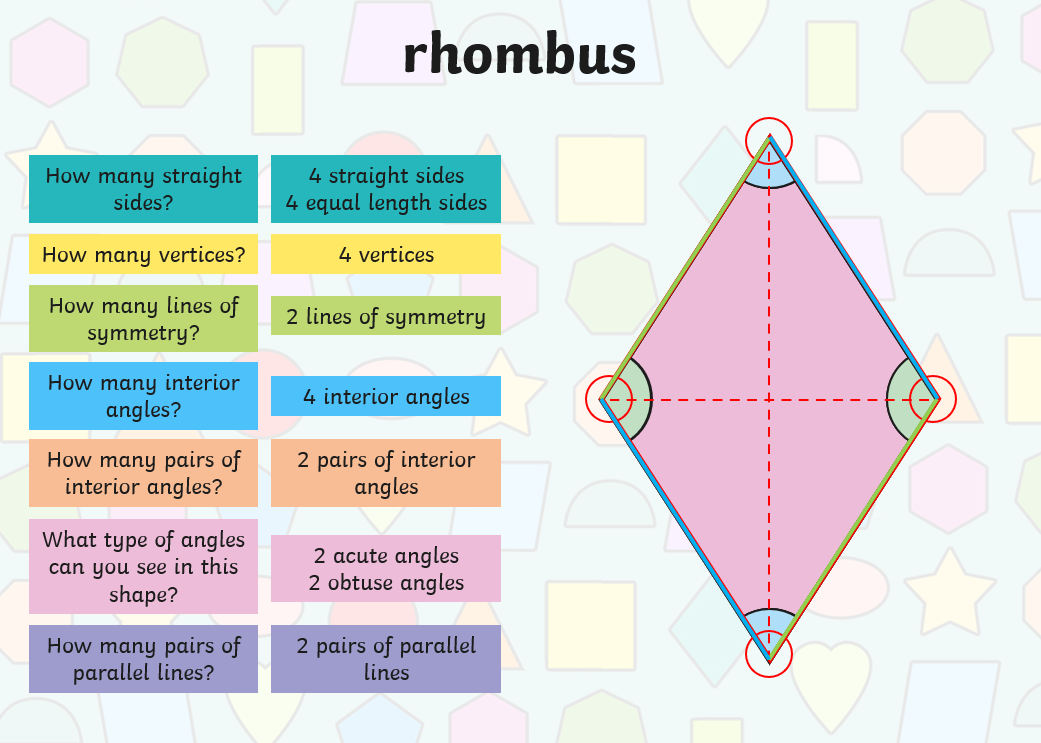
The rhombus shape has several defining properties that make it unique among quadrilaterals. The most important property is that all four sides are equal in length. This equality of sides ensures that the shape remains balanced and symmetrical, even though its angles may vary. Another important property is that opposite sides of a rhombus are parallel, which classifies it as a special type of parallelogram.
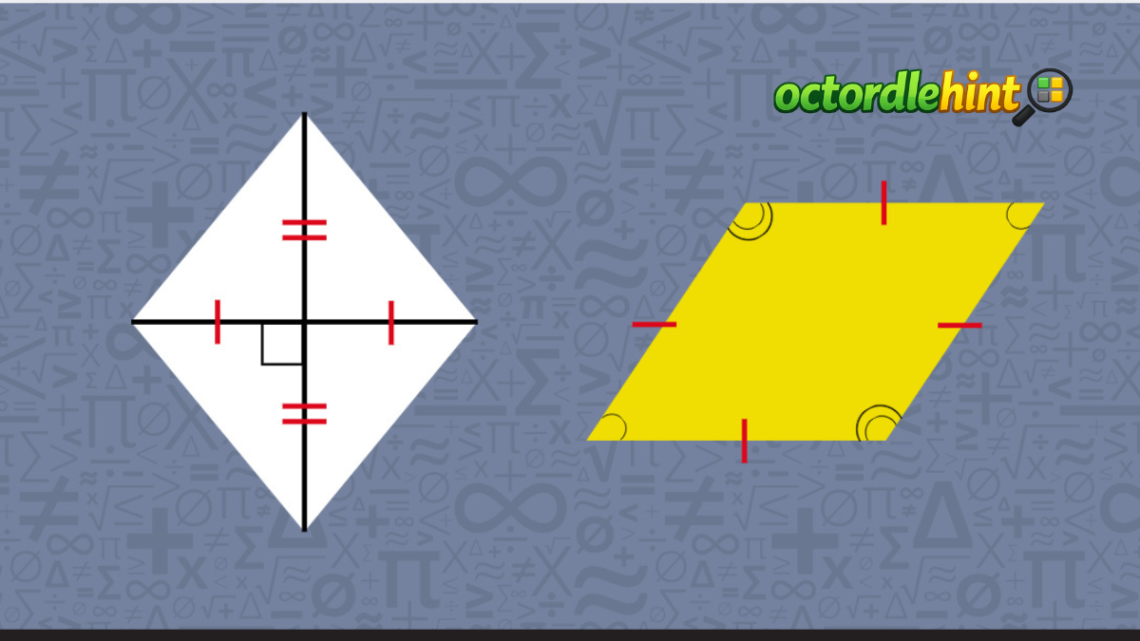
In addition to side and parallel properties, the angles of a rhombus also follow specific rules. Opposite angles in a rhombus are always equal, while adjacent angles are supplementary, meaning they add up to 180 degrees. This angle relationship is useful when solving geometry problems involving unknown values. Another interesting feature of a rhombus is its diagonals, which intersect each other at right angles (90 degrees). These diagonals not only bisect each other but also divide the shape into four congruent right-angled triangles.
Symmetry is another key characteristic of a rhombus. It has two lines of symmetry along its diagonals. This means the shape can be folded along these lines, and both halves will match perfectly. These properties make the rhombus a highly structured and predictable shape in geometry, allowing students to easily apply formulas and solve related problems.
Rhombus Shape Formulas: Area and Perimeter Explained
Understanding formulas related to the rhombus shape is essential for solving mathematical problems efficiently. One of the most basic formulas is the perimeter of a rhombus. Since all four sides are equal, the perimeter is calculated using the formula: Perimeter = 4 × side. This simple formula makes it easy to find the total boundary length of the shape.
The area of a rhombus can be calculated in different ways depending on the given information. The most common method is using diagonals. The formula is: Area = 1/2 × d₁ × d₂, where d₁ and d₂ are the lengths of the diagonals. This method is especially useful when the side length is not given. Another method is using base and height, where Area = base × height. This is similar to a parallelogram, since a rhombus is a special type of parallelogram.
In more advanced problems, students may also use trigonometric methods to find the area when angles are involved. Understanding when to apply each formula is very important. Many students make mistakes by confusing diagonals with sides or using the wrong formula in exams. Practicing different types of problems helps in building confidence and accuracy when dealing with rhombus shape calculations.
Difference Between Rhombus and Other Quadrilaterals
Although the rhombus shape belongs to the quadrilateral family, it is often confused with other shapes like squares, rectangles, and kites. The main difference between a rhombus and a square is that while both have equal sides, a square has all right angles, whereas a rhombus does not necessarily have 90-degree angles. This makes the square a special case of a rhombus.
When comparing a rhombus with a rectangle, the differences become clearer. A rectangle has opposite sides equal but not all four sides equal, while a rhombus has all four sides equal but angles are not always right angles. A kite shape, on the other hand, has two pairs of adjacent equal sides, but not all sides are equal like in a rhombus. These distinctions are important for identifying shapes correctly in geometry problems.
Understanding these differences helps students avoid confusion during exams and improves their ability to recognize geometric patterns. Visual comparison and practice diagrams are very helpful in mastering these concepts. Once the differences are clear, solving classification-based questions becomes much easier and more accurate.
Diagonals and Angles in a Rhombus Shape
The diagonals of a rhombus are one of its most interesting features. They intersect each other at right angles, forming 90-degree angles at the point of intersection. This property divides the rhombus into four right-angled triangles, which is useful for solving area and length problems. The diagonals also bisect each other, meaning they cut each other into equal halves.
Another important aspect is that diagonals bisect the opposite angles of the rhombus. This means each diagonal divides the corner angles into two equal parts. This property is very helpful in solving angle-based problems where some values are unknown. By using these relationships, students can easily calculate missing angles or side lengths.
In many cases, the Pythagorean theorem can also be applied within the triangles formed by the diagonals. This helps in finding missing side lengths when diagonal measurements are known. Understanding diagonals deeply allows students to solve complex geometry questions with confidence and accuracy.
Real-Life Applications of Rhombus Shape
The rhombus shape is not limited to textbooks; it is widely used in real life. One of the most common examples is in floor tiles and decorative patterns. Many architectural designs use rhombus shapes to create visually appealing and symmetrical structures. This is because the shape naturally creates balance and repetition in design.
In art and graphic design, rhombus patterns are used to create modern and geometric visuals. Logos, wallpapers, and fabric designs often include rhombus shapes due to their aesthetic appeal. In engineering and construction, rhombus-based structures are used to distribute force evenly and create strong frameworks.
Even everyday objects like kites resemble a rhombus shape. This shows how geometry is deeply connected to real-world objects. Understanding the rhombus helps students see the practical side of mathematics and appreciate how shapes influence design and structure in daily life.
Conclusion
The rhombus shape is a fundamental geometric figure that plays an important role in mathematics and real-life applications. With its equal sides, parallel structure, and unique diagonal properties, it offers a wide range of learning opportunities for students. From basic definitions to advanced formulas, understanding the rhombus helps build strong mathematical foundations.
By mastering its properties, formulas, and differences from other shapes, students can improve their problem-solving skills and perform better in exams. The rhombus is not just a shape in geometry; it is a key concept that connects theory with practical applications in the real world.
FAQs
What is a rhombus shape?
A rhombus is a four-sided shape where all sides are equal in length and opposite sides are parallel.
How do you find the area of a rhombus?
The area can be found using the formula: 1/2 × diagonal 1 × diagonal 2.
Is every square a rhombus?
Yes, every square is a rhombus because it has four equal sides, but not every rhombus is a square.
What makes a rhombus different from a rectangle?
A rhombus has all sides equal, while a rectangle has only opposite sides equal.
Where is the rhombus shape used in real life?
It is used in tiles, architecture, art designs, and everyday objects like kites.
Also Read: ai trading bot free