The Cartesian plane is one of the most important foundations in mathematics, especially in geometry, algebra, and coordinate systems. It provides a structured way to represent numbers visually using a two-dimensional grid. This system allows us to locate points, draw graphs, and understand mathematical relationships in a simple and visual manner. The Cartesian plane is widely used in education, science, engineering, computer graphics, and data analysis, making it an essential concept for students and professionals alike.
The idea of the Cartesian plane was introduced by the famous mathematician René Descartes, which is why it is also called the Cartesian coordinate system. His invention revolutionized mathematics by connecting algebra with geometry. Instead of solving equations only in abstract form, the Cartesian allows us to visualize them. This makes complex problems easier to understand and solve. Today, it plays a major role in real-world applications such as mapping systems, GPS navigation, architecture designs, and even video game development.
Structure and Components of the Cartesian Plane
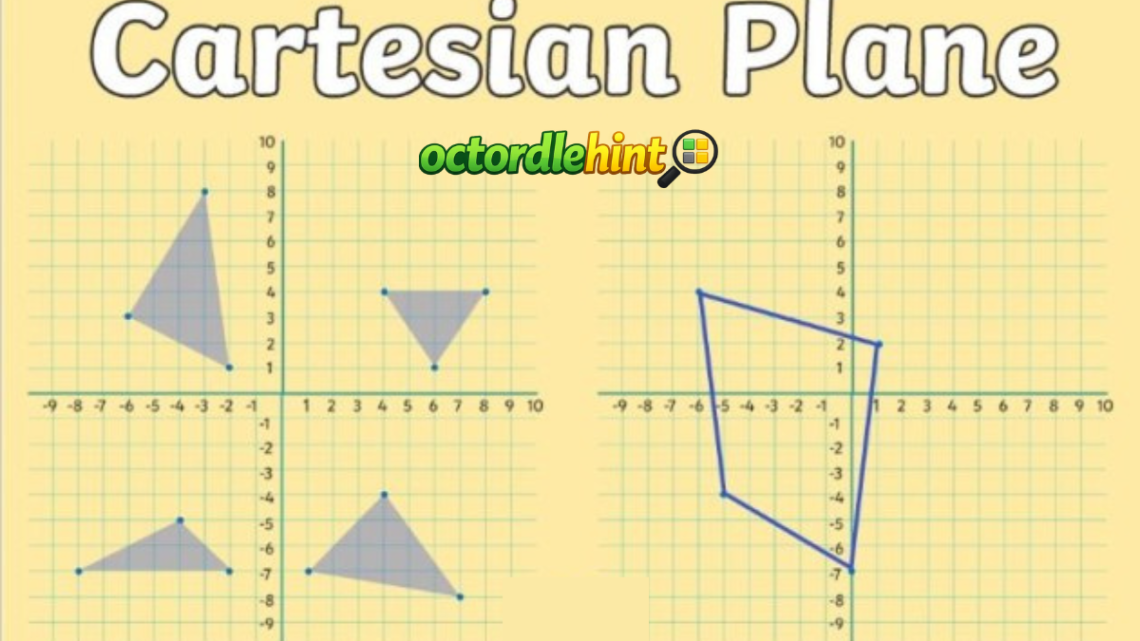
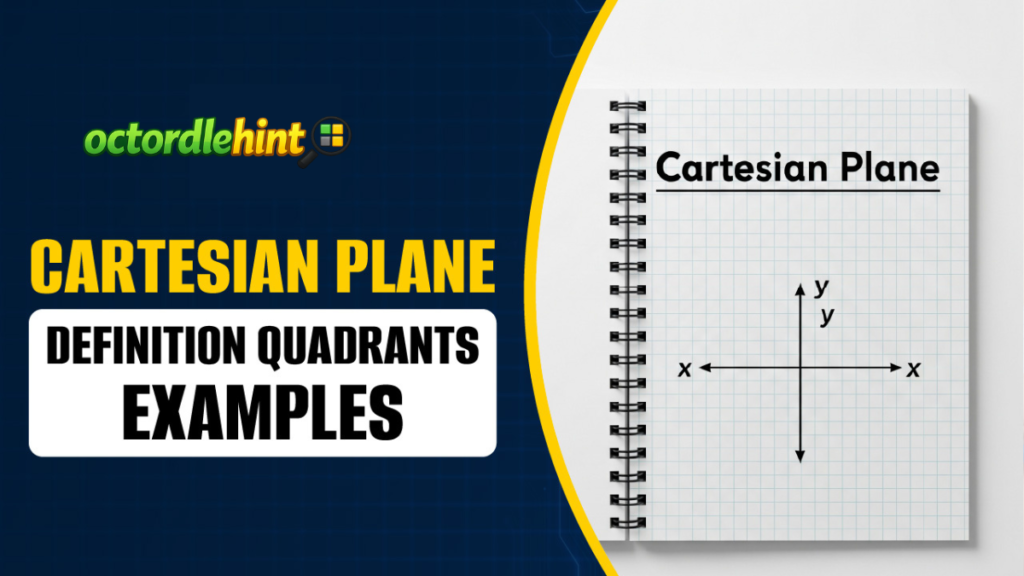
The Cartesian plane is built using two perpendicular number lines that create a grid system. These lines are called the X-axis (horizontal) and Y-axis (vertical). The point where both axes meet is called the origin, represented as (0, 0). This origin acts as the central reference point for all coordinates on the plane. Every point on the Cartesian is measured based on its distance from this origin, making it easy to identify locations precisely.
The plane is divided into four sections known as quadrants. Each quadrant has a unique combination of positive and negative values. In Quadrant I, both X and Y values are positive. In Quadrant II, X is negative while Y is positive. In Quadrant III, both values are negative, and in Quadrant IV, X is positive while Y is negative. These quadrants help in organizing the entire coordinate system, making it easier to locate and analyze points. Understanding the structure of the Cartesian plane is essential for graph plotting and solving mathematical problems accurately.
Coordinates and Plotting Points
Coordinates are the basic building blocks of the Cartesian plane. Each point is represented using an ordered pair written as (x, y). The first number, called the X-coordinate, shows the horizontal position, while the second number, called the Y-coordinate, shows the vertical position. Together, these values tell us exactly where a point is located on the grid. For example, the point (3, 2) means moving 3 units right and 2 units up from the origin.
Plotting points on the Cartesian plane is a simple but powerful skill. To plot a point, you start at the origin and move along the X-axis first, then move up or down along the Y-axis. Positive values move right and upward, while negative values move left and downward. By repeating this process, multiple points can be plotted to form shapes, lines, and graphs. This technique is widely used in mathematics to visually represent equations and data trends.
Understanding coordinates also helps in measuring distances between points and analyzing geometric shapes. Although more advanced formulas exist for calculating distances, the basic idea comes from understanding how far points are from each other on the grid. This makes the Cartesian plane an essential tool for both simple and advanced mathematical learning.
Graphing on the Cartesian Plane
Graphing is one of the most powerful applications of the Cartesian plane. It allows us to visually represent mathematical equations and understand relationships between variables. One of the most common types of graphs is a straight-line graph, which represents linear equations such as y = mx + c. In this equation, “m” represents the slope, while “c” represents the point where the line crosses the Y-axis. By plotting values, we can draw a straight line that represents the equation.
Apart from straight lines, the Cartesian plane is also used to graph curves and complex shapes. These curves represent non-linear equations and show how values change in different ways. For example, parabolas, circles, and waves can all be drawn using coordinate points. This helps in understanding patterns and mathematical behavior more clearly. The ability to visualize equations makes learning much more interactive and easier to understand.
Graphs on the Cartesian plane are not only useful in mathematics but also in real-life data interpretation. Scientists, economists, and engineers use graphs to analyze trends, predict outcomes, and solve real-world problems. Whether it is tracking population growth, measuring speed over time, or analyzing financial data, graphing plays a key role in decision-making processes.
Applications of the Cartesian Plane in Real Life
The Cartesian plane is not just a mathematical concept; it has countless real-world applications. In education, it helps students understand algebra and geometry in a visual way. Instead of solving equations blindly, learners can see how numbers behave on a graph. This improves problem-solving skills and builds a strong mathematical foundation.
In science and engineering, the Cartesian plane is used to model physical systems. For example, in physics, it helps represent motion, force, and energy using graphs. Engineers use coordinate systems to design buildings, machines, and electronic circuits with precision. Even computer graphics rely heavily on the Cartesian plane to create images, animations, and video games. Every movement on a screen is calculated using coordinate points.
The Cartesian plane is also widely used in technology and navigation systems. GPS applications depend on coordinate systems to locate positions on Earth accurately. Businesses and economists use graphs to analyze data trends, stock market changes, and financial performance. This shows how deeply the Cartesian plane is connected to modern life, making it an essential tool in almost every field.
Conclusion
The Cartesian plane is a powerful mathematical system that connects numbers with visual representation. It helps us understand coordinates, plot points, and analyze relationships between variables in a clear and structured way. From basic school mathematics to advanced scientific research, it plays a crucial role in learning and problem-solving.
Its real-life applications in science, engineering, technology, and economics make it one of the most important concepts in mathematics. By mastering the Cartesian plane, students not only improve their mathematical skills but also gain a deeper understanding of how the world works through data and graphs.
FAQs
What is a Cartesian plane in simple terms?
The Cartesian plane is a grid system used to locate points using two numbers called coordinates.
Who invented the Cartesian plane?
It was invented by René Descartes, a French mathematician and philosopher.
How many quadrants are in a Cartesian plane?
There are four quadrants, each defined by positive and negative values of X and Y.
What is the origin in the Cartesian plane?
The origin is the point (0, 0) where the X-axis and Y-axis intersect.
Where is the Cartesian plane used in real life?
It is used in GPS systems, engineering, computer graphics, science, and business data analysis.
Why is the Cartesian plane important?
It helps visualize mathematical problems and makes it easier to understand equations and data patterns.
Also Read: rhombus shape